
Bandit Action Camera
When we designed the TomTom Bandit, action cameras were sold based on specs rather than user experience. Cameras were difficult to operate, and even worse, finding the best bits of hours of footage was difficult, resulting in most footage ending up unused on your computer.
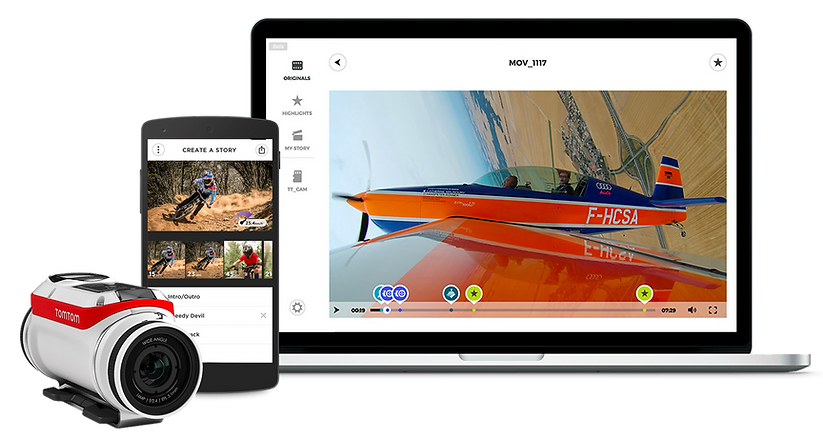
We disrupted the action camera market by making it extremely easy to create a video, right after the action. You no longer needed to wait to get home and copy all content to a computer, but instead could access streamed highlight clips on your mobile and create a movie right after the action.
My role
I led the user experience team for this cross platform project. This ranged from pitching my user experience concept to the TomTom management board to convince them to invest in this project, all the way through to working with development teams in different locations to bring the Bandit ecosystem to market. Leading a team of four designers, I was responsible for the design of the camera UI, mobile- and desktop applications.
I believe user experience is much more than the design of software applications only. Therefore, I pushed for great influence over the hardware design of the camera to ensure a consistent experience across hardware and software. I drove decisions around placement, shape and functionality of buttons, how to release the ‘batt-stick’ and lens cap and the design of different types of mounts for the camera.

Create a video right after the action, in seconds
To deliver our vision to create a video right after the action, the mobile application was a key differentiator. Therefore, the app had to tackle two major problems with incumbent products: the lengthy download time to access footage and the labour-intensive process of scene selection.
To solve the former we gave the user instant access; having the camera stream the footage in low resolution to the app. After composing your video, the camera would only send selected scenes in high-res, saving the user huge amounts of ‘download time’.
By providing automatically and manually generated highlights the user could quickly create an exciting video using the intuitive interface to tweak and enhance with music and overlays.
I was delighted to hear customers actually created videos in the backseat of the car, minutes after their action adventures.
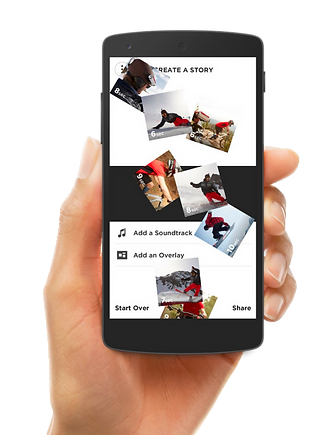
We invented the ‘shake to create’ feature to lower the barrier to start creating movies and make the process of doing so more fun. Together with the software team, we defined the algorithm to select and order scenes.
The marketing team latched onto this, and as a result, the feature became an important part of the launch campaign.
To ensure a smooth user interaction with the camera, we had to break with the techy menus of incumbent action cameras. We proposed a highly visual and simple menu structure instead. We fought to get a (more expensive) relatively large display - similar to the one used in our sports watches - to help achieve that.
Unlike the convention, we had chosen for separate buttons to start and stop recording - with the great advantage of never having to worry whether you have just turned the camera on or off when it is mounted out of sight (e.g. on a helmet). Pressing the on button while recording creates a highlight in the footage and can therefore be used to tag interesting moments manually (in addition to the automatic tagging based on the sensors in the camera).


UX Research
We have done extensive user research throughout the design process together with the user research team. The research helped us to understand the pain points with incumbent products and the flaws in our flows. The insights also allowed us to propose improvements for the hardware design, the packaging and in-the-box materials.
We made demos to test our initial flows of the mobile app, desktop app and the camera UI. First using foam models and - later - early builds, we tested usability of the hardware design.
Most of the research took place before launch, but it did not stop there. We also interviewed customers after the product had been launched to understand which improvements to include in software updates and the next generation of the camera.


“I want to do my sports, not spend my time on technology to capture my moves.”
Research participant